China Powder Metallurgy Gear Manufacturer
Mastering Precision and Performance: The Comprehensive Guide to GM Powder Metallurgy Gears
In the demanding world of mechanical power transmission, the quest for components that deliver superior strength, intricate design, and cost-effective mass production is relentless. At the forefront of this innovation stands Powder Metallurgy (PM) gear technology. GM, a leader in advanced manufacturing solutions, has perfected this process to produce gears that consistently outperform traditional machined counterparts. PM is a metal-forming process where fine, alloyed metal powders are compacted under high pressure into a precise shape (a "green" part) and then sintered at high temperatures, bonding the particles into a solid, high-strength metal component. This method is not merely an alternative to cutting or casting; it represents a paradigm shift in gear manufacturing, enabling complex geometries, consistent material properties, and remarkable material efficiency with minimal waste.
GM's expertise lies in optimizing every stage of this process—from powder alloy selection and die design to sintering and secondary operations—to create PM gears that meet the most stringent application requirements across automotive, aerospace, power tools, medical devices, and industrial machinery.
Why Choose GM Powder Metallurgy Gears?
- Net or Near-Net Shape Production: GM PM gears are formed to final dimensions with exceptional accuracy, drastically reducing or eliminating the need for costly, time-consuming secondary machining.
- Material Efficiency & Sustainability: The process utilizes over 97% of the raw material, minimizing scrap compared to machining from bar stock. This aligns with sustainable manufacturing goals and reduces material costs.
- Complex Geometry in a Single Press: Internal and external splines, helical teeth, hubs, flanges, and even multiple gear stages can be consolidated into a single, robust component, simplifying assembly and improving reliability.
- Consistent High Quality & Reproducibility: Once the tooling is perfected, every production run yields gears with identical metallurgical properties and dimensional tolerances, ensuring predictable performance.
- Superior Strength & Wear Resistance: Through controlled sintering and optional post-treatments, GM can achieve densities and microstructures that provide excellent fatigue strength, impact resistance, and durability.
- Cost-Effectiveness at High Volumes: For medium to high-volume production, PM is often the most economical choice due to high production rates, low labor content, and minimal material waste.
Available Secondary Operations & Enhancements
- Heat Treatment: Case hardening (carburizing, carbonitriding), through hardening, and tempering to increase surface hardness and core strength.
- Surface Densification: A process to seal the surface porosity of the gear teeth, dramatically improving contact fatigue strength and noise performance.
- Steam Treating: Creates a magnetite (Fe3O4) oxide layer for improved corrosion resistance and surface hardness.
- Oil Impregnation: Pores are filled with oil, providing self-lubrication for the life of the gear, ideal for sealed or maintenance-free assemblies.
- Machining: Precision drilling, tapping, milling, or turning of features that cannot be formed in the press.
- Grinding & Honing: For achieving ultra-precise tooth profiles, lead, and pitch for high-speed or quiet operation applications.
- Plating & Coating: Zinc plating, nickel plating, or specialty coatings for enhanced corrosion protection.
Frequently Asked Questions (FAQ) About Powder Metallurgy Gears
Q: What are the size and weight limitations for PM gears?
A: GM's standard press capacities allow us to produce gears with outside diameters typically up to 120mm (4.7 inches) and weights up to 2.5kg (5.5 lbs). For larger components, we offer specialized processes and can discuss specific project requirements. The practical limitation is often the size and force capacity of the compacting press needed to achieve uniform density.
Q: Can you produce helical gears and bevel gears using powder metallurgy?
A: Absolutely. Helical gears are commonly produced via PM, as the tooling can create the necessary helix angle during compaction. Straight bevel gears are also readily produced. Spiral bevel gears are more challenging due to their complex curvature and typically require secondary machining of the tooth form after a pre-form is created via PM. GM engineers can advise on the most cost-effective approach for your specific gear geometry.
Q: How does the cost of a PM gear compare to a machined gear, especially for low-volume production?
A: For low-volume production (e.g., prototypes or hundreds of pieces), machined gears may have a lower per-part cost because PM requires expensive, dedicated tooling (dies). The primary economic advantage of PM is realized in medium to high-volume production (thousands to millions of parts), where the tooling cost is amortized over many parts, and the high-speed, low-waste production process significantly reduces unit cost. GM offers prototyping services using soft tooling or machined PM blanks to help customers test designs before committing to production tooling.
Q: What about noise and vibration? Are PM gears quieter?
A> Properly designed and manufactured PM gears can be very quiet. The inherent damping characteristics of the material's microstructure can reduce vibration. Furthermore, the excellent dimensional consistency from part to part ensures smooth meshing. For the quietest operation, secondary operations like surface densification, grinding, or honing of the gear teeth are highly effective and are standard offerings at GM for noise-sensitive applications like automotive transmissions or office equipment.
- View as

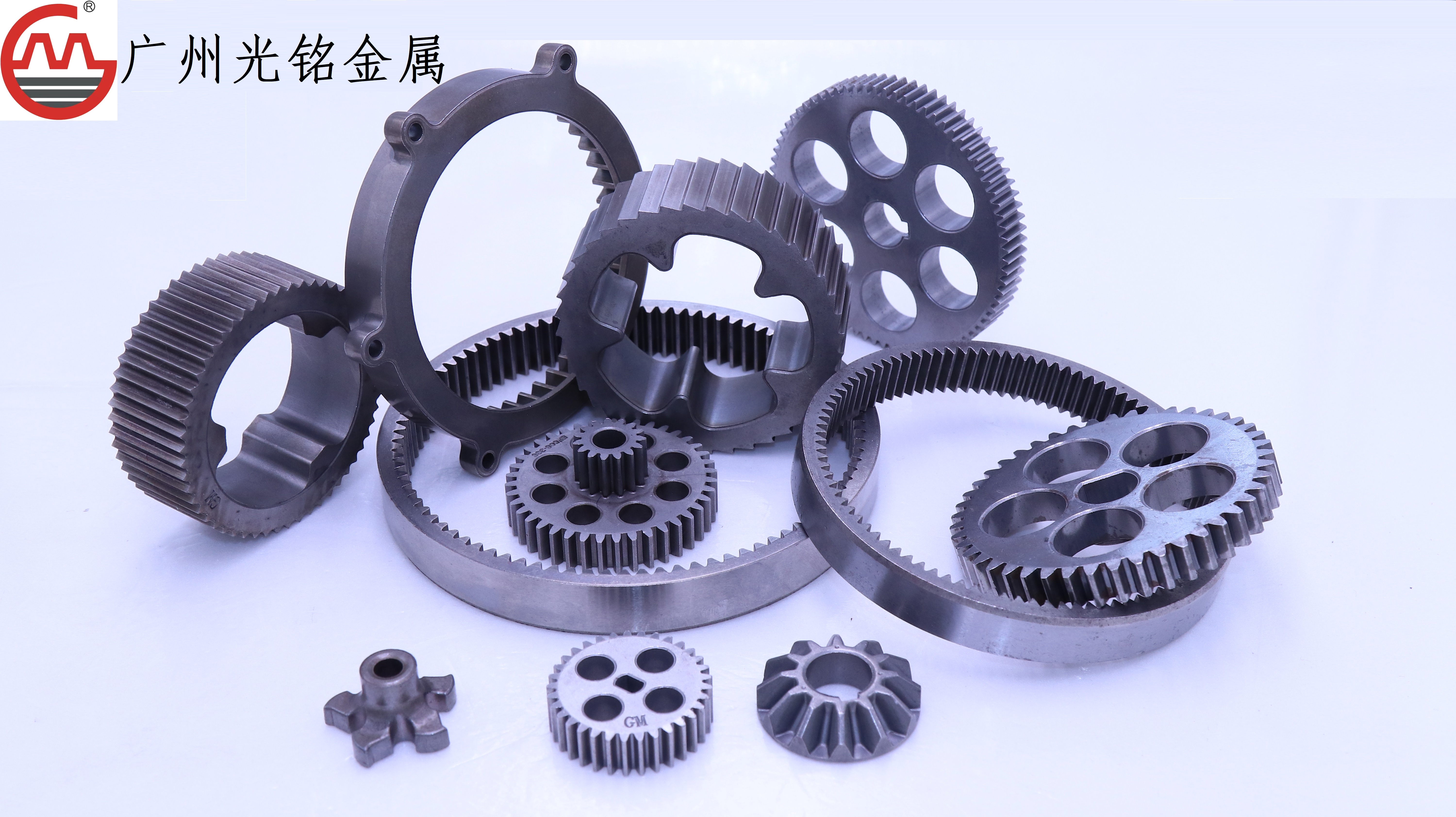
Spur Gear
Guangzhou Guangming Metal Products Co.,Ltd specializes in manufacturing spur gears with excellent tooth accuracy and durability. Our PM spur gears are widely applied in mechanical drives, appliance motors, and precision instruments for their quiet performance and reliable power transmission.

Bevel Gear
Guangzhou Guangming Metal Products Co.,Ltd offers bevel gears designed for transmitting power between intersecting shafts at various angles. Our bevel gears provide high efficiency, smooth operation, and excellent durability in automotive differentials, power tools, and adjusting mechanisms.

Planetary Carrier
Guangzhou Guangming Metal Products Co.,Ltd is a professional manufacturer of powder metallurgy planetary carriers, a key component in planetary gear sets. Our PM planetary carriers are designed for high rigidity, precise hole positioning, and lightweight construction, ensuring stable support for planetary gears in various transmission systems.

Helical Gear
Guangzhou Guangming Metal Products Co.,Ltd manufactures helical gears known for their smooth and quiet operation. Our PM helical gears feature angled teeth that provide gradual engagement, reducing noise and vibration in high-speed applications such as automotive transmissions and industrial machinery.

Double Helical Gear
Guangzhou Guangming Metal Products Co.,Ltd offers double helical gears, featuring axial force cancellation and excellent load distribution performance. Our double helical gears are widely used in small appliance gear sets and industrial applications, especially in situations requiring high torque and minimal axial thrust.

PM Double Spur Gear
Guangzhou Guangming Metal Products Co.,Ltd specializes in manufacturing powder metallurgy gears, featuring two spur gear sections on a single axis for multi-stage speed reduction. Our PM dual spur gears provide precise gear ratios, high torque capacity, and compact design for various mechanical drives.
We manufacture durable, rugged powder metallurgy parts designed for Powder Metallurgy Gear. Get high-performance components built to withstand demanding environments. Check our price list and purchase high-quality Powder Metallurgy Gear accessories direct!